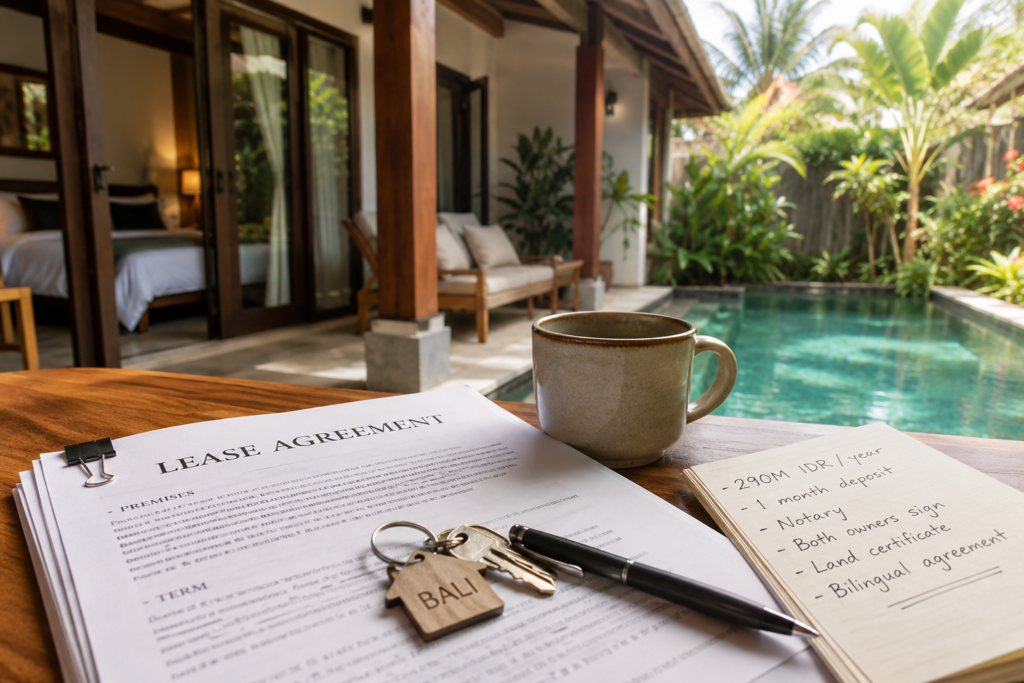
The Perfect Villa
In Part 1, I wrote about how chaotic renting a villa in Bali can be.
I found the villa. Two bedrooms, private pool, great location. I should have been celebrating. Instead, I was preparing to transfer nearly 300 million rupiah, about $17,000, to someone I’d known for less than a week.
Finding the villa turned out to be only half the battle. The harder part was figuring out how to safely hand over that much money in a foreign country to someone I barely knew.
Negotiating My Villa Lease in Bali
One thing I learned about renting a villa in Bali is that nearly everything is negotiable.
The initial asking price was 320 million IDR per year. I wasn’t fully comfortable committing to a full year. My preference was six months, so that if something went wrong (noisy neighbors, hidden issues, construction next door, or just not loving the area) I’d only be stuck for half the time. But the owner wanted 175 million for six months, and at that rate the economics stopped making sense. I’d be paying more than half the annual price for half the time.
We went back and forth and landed on 290 million for the year, plus a one-month security deposit. I also added a clause: if the owner decided to sell or enter a long-term lease with someone else, I’d have a structured way out of our agreement. I wanted protection for myself, but I also wanted it to feel fair to both sides.
The Manager Who Wasn’t Just the Manager
When I first viewed the villa, I met a guy named Putu, who introduced himself as the manager. He explained the owners were Balinese and Australian. Nothing seemed unusual.
As we got closer to signing, I asked to review the land certificate, and that’s where things got interesting. Putu was reluctant, saying the owners weren’t comfortable sharing it. I insisted. I was about to wire nearly 300 million rupiah to someone I’d known for a week, and I needed to know he actually had the right to rent me this place.
Eventually Putu came clean. He wasn’t just the manager. He was one of the owners, and he’d just preferred not to lead with that. I appreciated the honesty, even if it came later than I’d have liked. But I still wanted the paperwork.
The Lease Signing Got Interesting
I hired an Indonesian notary and paid 3.6 million rupiah to notarize the agreement. During the meeting, he flagged a problem: the lease identified the villa by name and address, but villa names can change. He recommended pulling additional details from the land records to make the property unambiguous. For another 500,000 rupiah, I had him make the correction.
Then we reviewed the land certificate together, and I learned Putu wasn’t the only owner. His brother was also listed. That had never come up.
At that point, my stomach dropped.
I was sitting in a notary’s office in a foreign country, trying to negotiate a contract in a legal system I didn’t fully understand, and I was still learning new information about who actually owned the property.
I wasn’t assuming anyone was trying to deceive me. But I was annoyed. This was significant information, and I didn’t want to be discovering it at the lease signing. I wanted it sorted out well beforehand.
That’s when I stopped thinking about the villa and started thinking about risk.
If there are two owners, I want both owners signing the agreement. If the villa’s name can change, I want the property identified by the underlying land records. I wasn’t looking for perfection. I was trying to remove as much ambiguity as reasonably possible before wiring nearly 300 million rupiah to someone I’d known for less than a week.
Fortunately, the fixes were straightforward. The brother signed, the notary witnessed everything, and by the end of the meeting I knew exactly who owned the property, exactly what I was leasing, and had every owner’s signature on a bilingual, notarized agreement.
That felt like a pretty good return on a few million rupiah.
In the end, I felt something unexpected: relief.
The lease I’d originally received was basic and left a lot of questions unanswered. The version I walked out with wasn’t perfect, but it was far better.
Every owner had signed it. The property was clearly identified. The agreement was bilingual. The notary had witnessed the signing.
Most importantly, I no longer felt like I was signing a half-assed lease and hoping for the best.
I felt like I’d done my homework.
My Biggest Lesson
None of this means anyone was trying to scam me. Co-ownership is common in Indonesia, and people often wear multiple hats.
But this experience reinforced something I’ve learned repeatedly while traveling: when you’re dealing with unfamiliar systems and a lot of money, it’s worth slowing down and asking uncomfortable questions.
A few extra hours of due diligence bought me something valuable: confidence.
What I’d Do Again When Renting a Villa in Bali
If I were renting another villa tomorrow, I’d do exactly the same things:
- Negotiate everything.
- Verify who actually owns the property.
- Review the land certificate.
- Use a bilingual agreement.
- Hire a notary.
- Make sure every legal owner signs.
None of those steps guarantee a perfect outcome and if I end up renting a villa in Bali again, I’d follow the same process.
But they dramatically reduce the number of surprises available to you.
Disclaimer: This post reflects my personal experience renting a villa in Bali and should not be considered legal advice. Property laws, leasing practices, and individual circumstances vary. If you’re entering into a lease in Indonesia, consider consulting a qualified Indonesian attorney or notary regarding your specific situation.
1 thought on “Renting a Villa in Bali: What I Learned Signing a $17,000 Villa Lease”